
1. Executive Summary
The paper measures modern canvas fingerprinting at web scale and shows that the test canvas itself can identify the fingerprinter. Identical rendered canvases group deployments across sites, making vendor footprints visible even when script origins are masked, bundled, routed through subdomains, or served from common infrastructure.
The authors found canvas fingerprinting on 12.7% of successfully crawled popular sites and 9.9% of successfully crawled tail sites. They also found that the ecosystem is concentrated: popular sites generated 504 unique fingerprinting canvases, tail sites generated 288, and twelve attributed services covered most sites that generated test canvases.
2. Research Question
The paper asks how common canvas fingerprinting is in 2025, whether identical test canvases can reveal the service or vendor responsible, and what deployment context suggests about tracking, security, advertising, and defense evasion.
Prevalence
How many popular and less-popular homepages extract canvases that look fingerprintable under the paper's heuristics?
Clustering
Can identical toDataURL outputs group sites using the same deterministic test canvas?
Attribution
Can demos, known customers, script URL patterns, and script contents tie canvas groups to named fingerprinting services?
Context
Do blocklists, ad blockers, first-party serving, subdomain routing, and repeated-render checks change how these deployments should be interpreted?
3. Method
The crawl used the May 2025 Tranco ranking and visited homepages from two site sets: the top 20,000 sites and a random sample of 20,000 sites ranked 20,001 through 1,000,000. The core prevalence analysis used 16,276 successfully crawled popular sites and 17,260 successfully crawled tail sites.
| Step | Paper method | Review significance |
|---|---|---|
| Corpus | Top-level pages from popular and tail Tranco site sets in May 2025. | Results are homepage crawl measurements, not whole-site or whole-web rates. |
| Instrumentation | Modified DuckDuckGo Tracker Radar Collector, a Puppeteer-based crawler, to intercept Canvas API calls and property accesses. | Records script source URLs, arguments, return values, and timestamps around canvas behavior. |
| Rendering control | Main crawl ran on one Intel Ubuntu 22.04.2 LTS machine; a second Apple M1 crawl checked grouping behavior. | Canvas bytes differed across machines, but identical-canvas site grouping stayed consistent in validation. |
| Consent and behavior | The crawler handled some anti-bot checks, scrolled pages, waited five seconds, and used autoconsent to opt in to common consent banners. | Automated measurement still may miss behavior behind login, checkout, or specific user actions. |
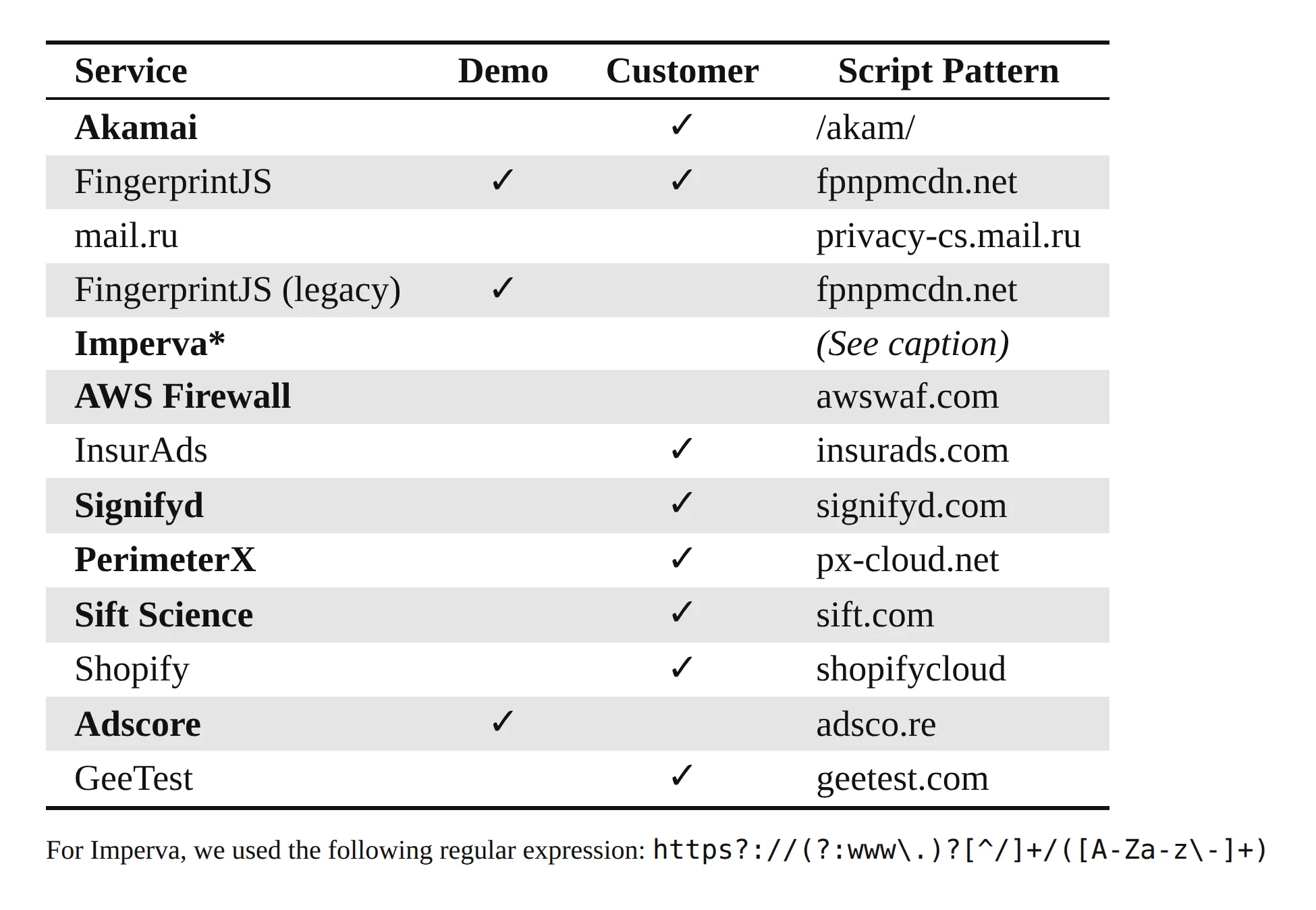
| Attribution | Vendor attribution combined public demos, known customer crawls, script URL patterns, and script-content patterns. | Attribution is evidence-backed but should be treated as a review classification, not complete ground truth. |
4. Fingerprintable Canvas Detection
The paper focuses on extracted canvases because a toDataURL value captures the rendered result of previous Canvas API calls. It then removes likely benign cases with three high-level filters: lossy JPEG/WebP outputs, canvases smaller than 16 by 16 pixels, and canvases generated by scripts that also invoked animation-associated methods such as save and restore.
- Classifier result. After filtering, the paper classified 83% of extracted canvases across the popular and tail crawls as fingerprintable.
- Manual checks. The authors found all 200 sampled excluded canvases benign and found two false positives in a sample of 300 unique fingerprintable canvases; both false positives appeared on only one domain.
- Scope. The method is tuned for extracted deterministic test canvases, not every possible use of the Canvas API.
5. Prevalence and Clustering
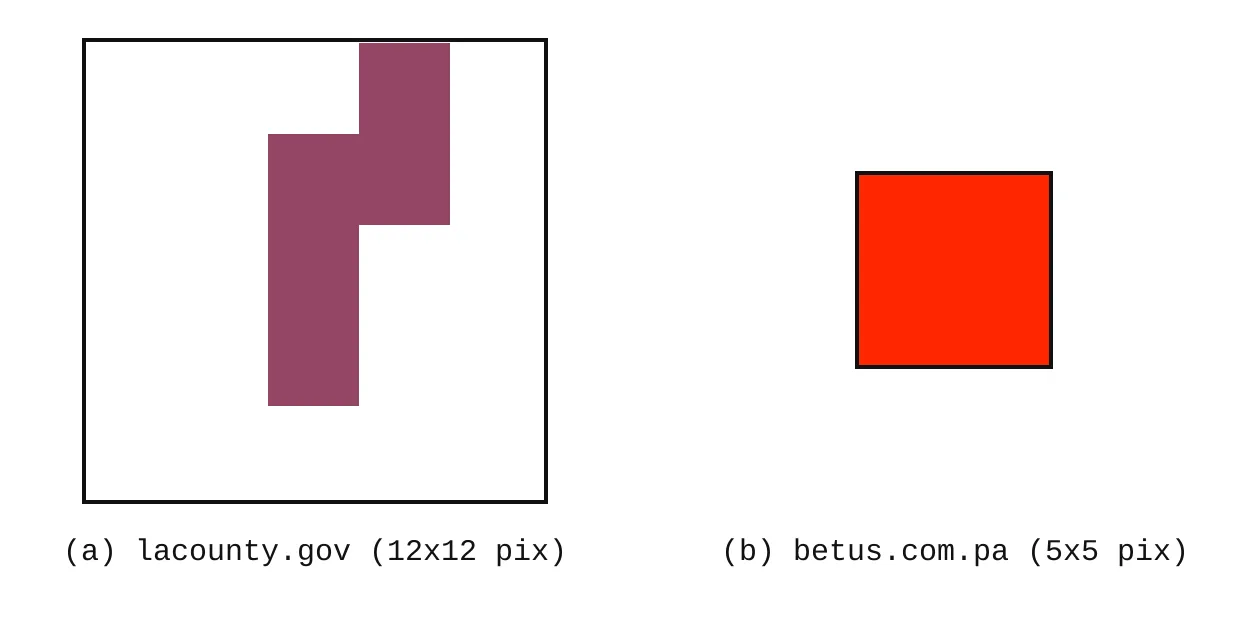
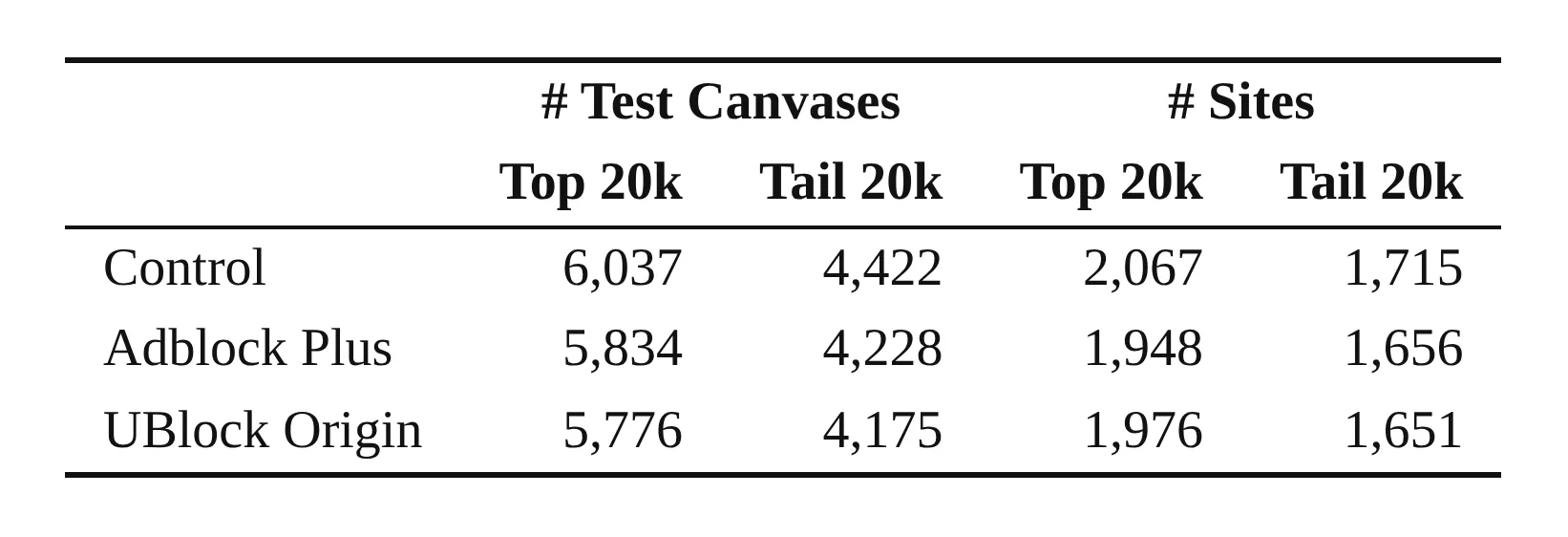
The central measurement result is moderate but widespread deployment. The crawler found 2,067 popular sites and 1,715 tail sites extracting at least one fingerprintable canvas. Among sites that generated a test canvas, the six most frequent canvases accounted for 70.1% of popular sites and 47.1% of tail sites.
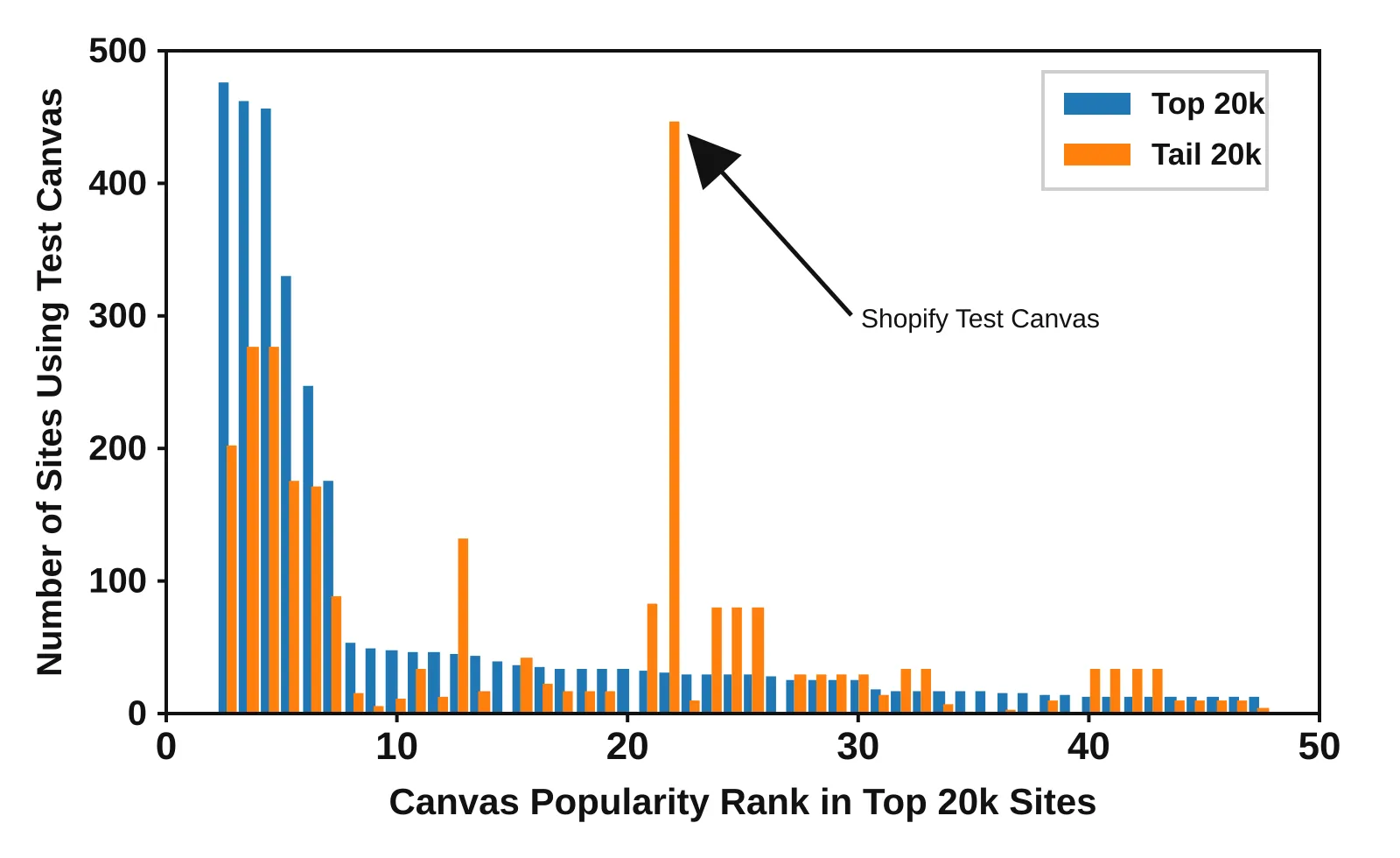
The paper treats identical test-canvas groups as an upper bound on a single organization's cross-site reach. That distinction matters: two organizations could independently choose the same canvas, while some vendors deliberately use per-site canvases that defeat grouping.
6. Vendor Attribution
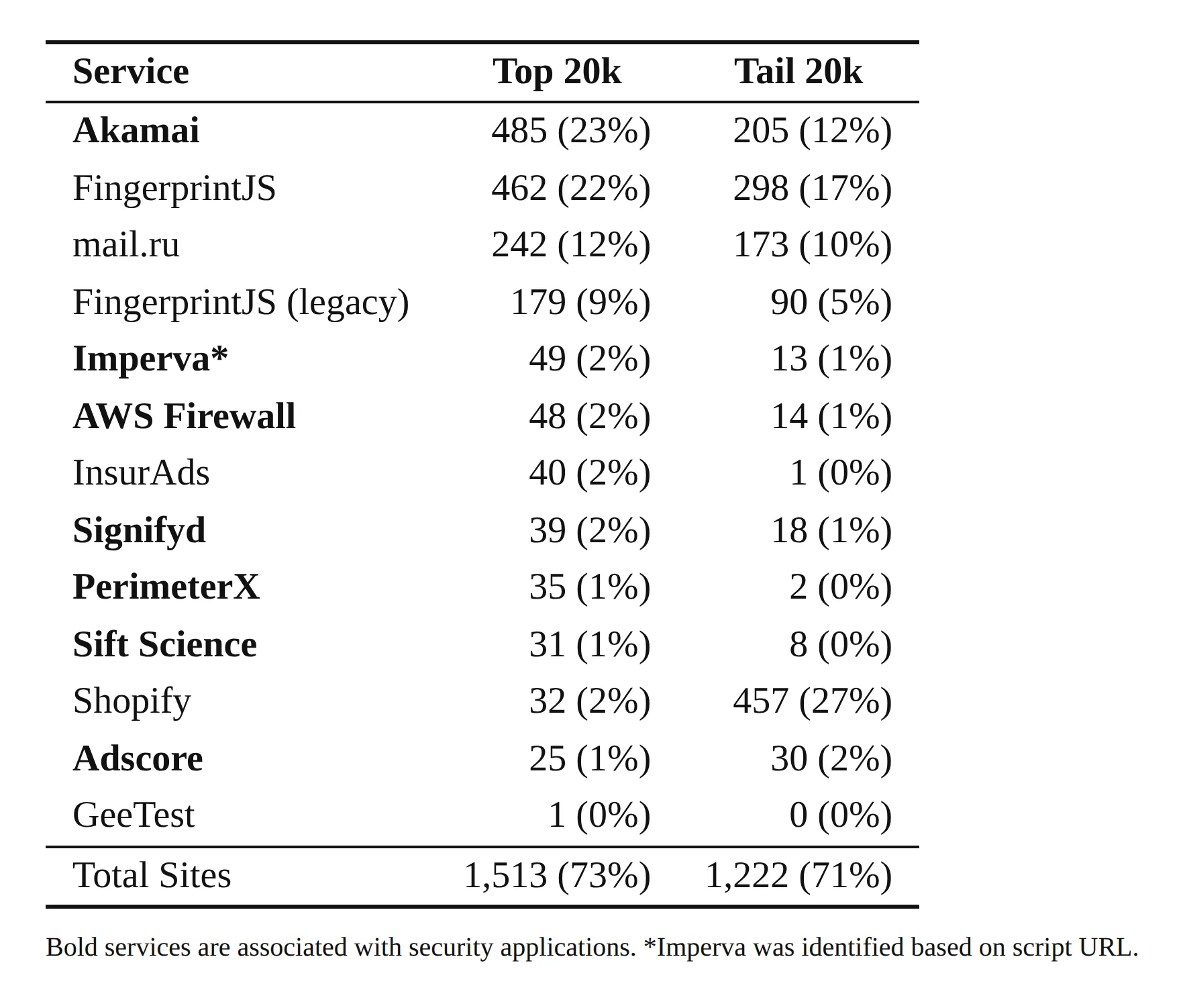
The authors attribute canvases for twelve prominent services, covering 73% of popular and 71% of tail sites that generated fingerprinting test canvases. The attributed set includes security-oriented services, mixed-use services, advertising or analytics-adjacent services, and bot-detection vendors.
| Vendor or service | Popular sites | Tail sites | Review note |
|---|---|---|---|
| Akamai | 485 | 205 | Largest attributed popular-site footprint; paper describes this as bot-detection context. |
| FingerprintJS | 462 | 298 | Mixed-use risk because commercial customers can use browser identifiers beyond security use cases. |
| mail.ru | 242 | 173 | Broad reach across sampled Russian-domain sites. |
| Shopify | 32 | 457 | Tail-site outlier linked to storefront performance monitoring. |
| Total attributed set | 1,513 | 1,222 | Totals across the services attributed in Table 1. |
7. Tracking, Blocklists, and Blockers
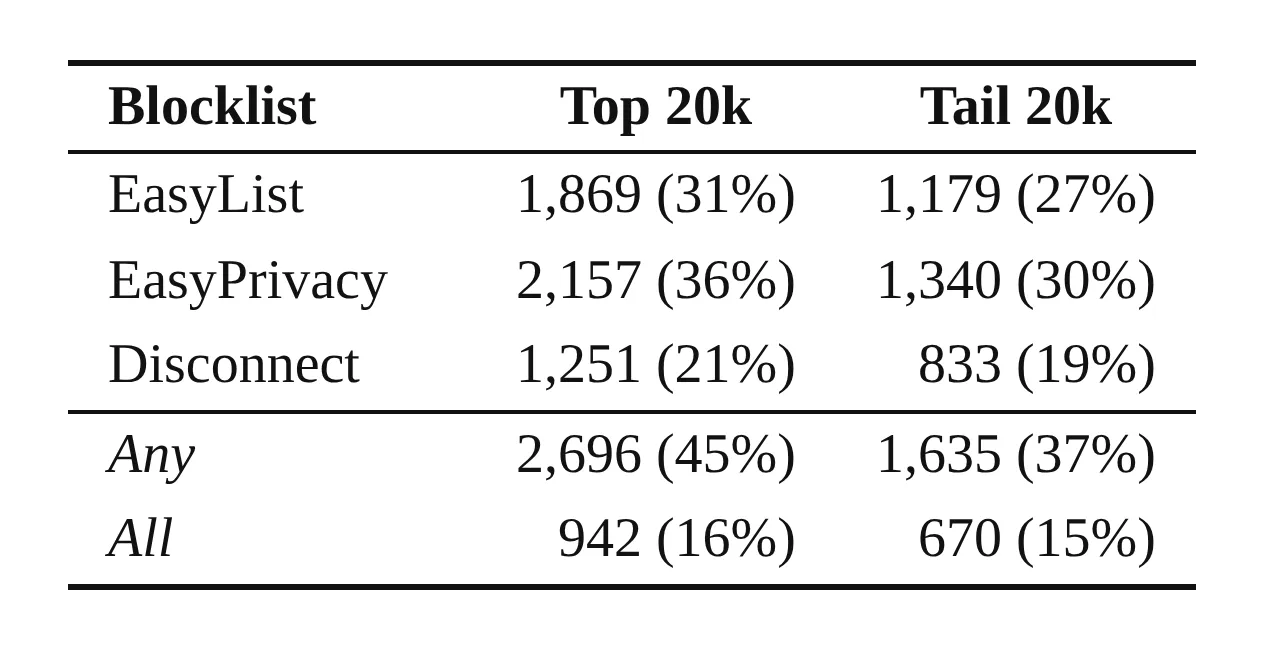
The paper uses blocklists as a proxy for advertising or tracking context, while explicitly treating them as imperfect evidence of intent. Scripts generating 2,696 top-20k test canvases and 1,635 tail test canvases appeared in at least one of EasyList, EasyPrivacy, or Disconnect. Scripts generating 942 top-20k canvases and 670 tail canvases matched all three lists.
Blocklist coverage
Table 4 shows substantial list coverage: 45% of top-20k test canvases and 37% of tail test canvases were generated by scripts included in at least one checked list.
Practical blocker impact
Installed ad blockers reduced observed canvas fingerprinting by only about 5%, much less than raw blocklist inclusion might suggest.
First-party serving
The paper reports that 49% of top-20k and 52% of tail canvas-fingerprinting sites had at least one test canvas rendered by a first-party-served script.
Origin masking
The gap is attributed to rule context, first-party exceptions, bundled JavaScript, CNAME cloaking, subdomain routing, and common CDN hosting.
8. Browser Defense Evasion
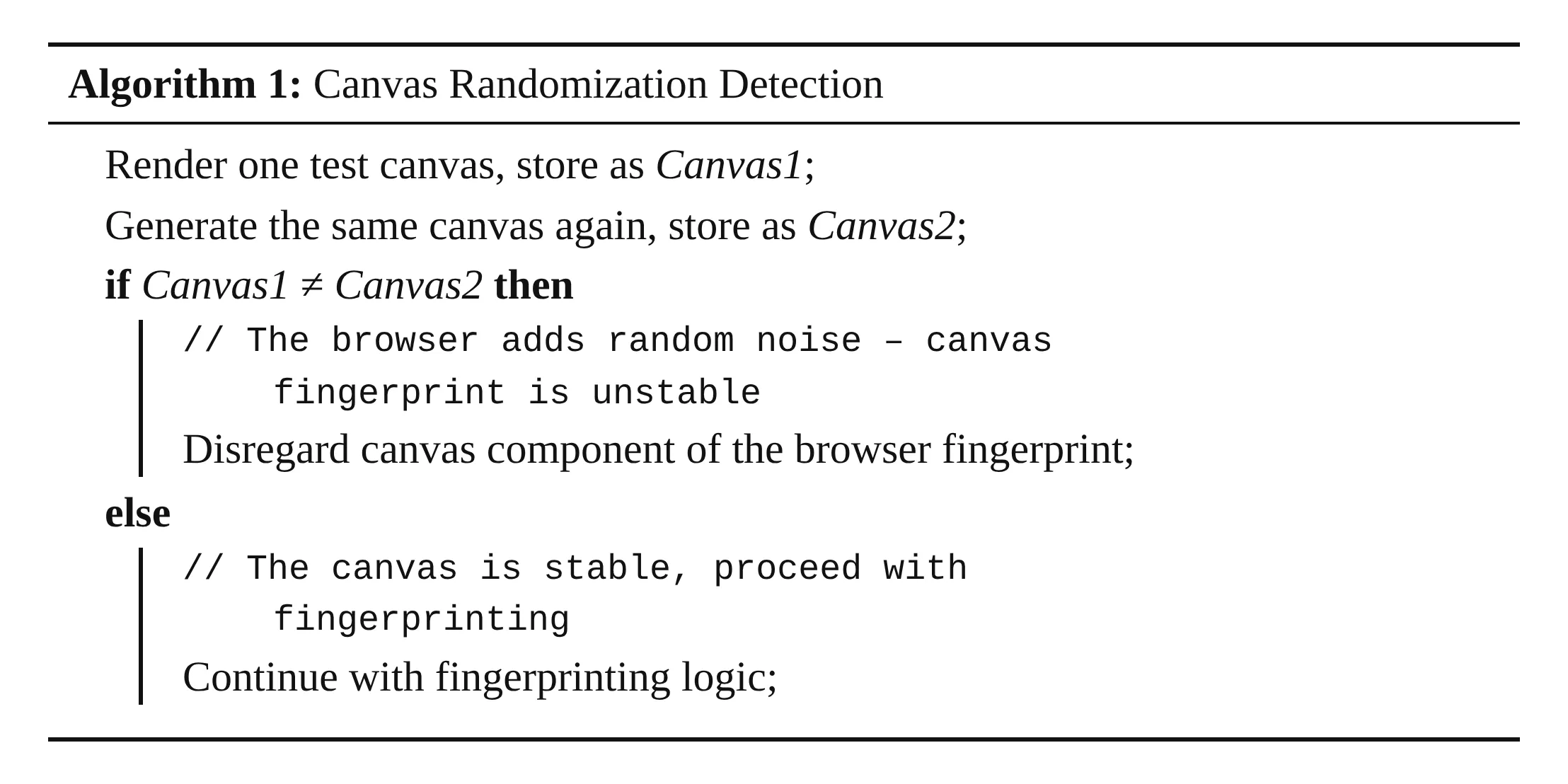
The paper highlights a practical weakness in canvas defenses that randomize output on every render. A fingerprinter can render the same deterministic canvas twice and compare outputs; if they differ, the script can disregard the canvas component or adapt its fingerprinting strategy.
- Observed check. Nearly half of sites performing canvas fingerprinting, 45%, had at least one test canvas generated and extracted twice.
- Open-source library behavior. The paper notes that a popular open-source fingerprinting library performs this kind of inconsistency check and disregards canvas when repeated renders differ.
- Scoped claim. The discussion applies to defenses that add different noise across repeated renders. The authors separately note that persistent per-session noise behaves differently.
9. Code Artifacts
These browser-console helpers are reconstructed from the paper's algorithm, measurement rules, and appendix tables. They are not author-provided source code.
Canvas randomization stability probe Reconstructed from Algorithm 1
(async () => {
  const hashText = async (value) => {
    const bytes = new TextEncoder().encode(value);
    const digest = await crypto.subtle.digest("SHA-256", bytes);

    return [...new Uint8Array(digest)]
      .map((byte) => byte.toString(16).padStart(2, "0"))
      .join("");
  };

  const renderTestCanvas = () => {
    const canvas = document.createElement("canvas");
    canvas.width = 300;
    canvas.height = 120;

    const context = canvas.getContext("2d", { willReadFrequently: true });
    if (!context) {
      throw new Error("2D canvas is unavailable");
    }

    context.textBaseline = "top";
    context.fillStyle = "#f60";
    context.fillRect(4, 4, 292, 112);
    context.fillStyle = "#069";
    context.font = "16px Arial";
    context.fillText("Cwm fjordbank glyphs vext quiz", 12, 16);
    context.font = "18px serif";
    context.fillText("Canvas fingerprint stability probe", 12, 44);
    context.strokeStyle = "rgba(0, 0, 0, 0.55)";
    context.beginPath();
    context.arc(238, 62, 28, 0, Math.PI * 2);
    context.stroke();

    return canvas.toDataURL("image/png");
  };

  const dataUrls = Array.from({ length: 5 }, renderTestCanvas);
  const hashes = await Promise.all(dataUrls.map(hashText));
  const uniqueHashes = [...new Set(hashes)];
  const result = {
    artifact: "canvas-randomization-stability-probe",
    stableAcrossRepeatedRenders: uniqueHashes.length === 1,
    renderCount: dataUrls.length,
    uniqueHashCount: uniqueHashes.length,
    hashes,
    dataUrlLengths: dataUrls.map((value) => value.length),
    interpretation:
      uniqueHashes.length === 1
        ? "Repeated renders were stable for this synthetic canvas."
        : "Repeated renders differed; per-render canvas noise or another nondeterministic factor may be present."
  };

  console.log(result);
  return result;
})()
Canvas extraction observer Inferred from Sections 3.1-3.2
(async () => {
  const globalName = "__canvasExtractionObserver";

  if (window[globalName] && window[globalName].restore) {
    window[globalName].restore();
  }

  const records = [];
  const canvasState = new WeakMap();
  const originals = {
    getContext: HTMLCanvasElement.prototype.getContext,
    toDataURL: HTMLCanvasElement.prototype.toDataURL,
    "2d.save": CanvasRenderingContext2D.prototype.save,
    "2d.restore": CanvasRenderingContext2D.prototype.restore
  };

  const ensureState = (canvas) => {
    if (!canvasState.has(canvas)) {
      canvasState.set(canvas, {
        methods: Object.create(null)
      });
    }

    return canvasState.get(canvas);
  };

  const stackUrls = () => {
    const stack = String(new Error().stack || "");

    return [...new Set(stack.match(/https?:\/\/[^\s)]+/g) || [])];
  };

  const classify = ({ canvas, mimeType, state }) => {
    const excludedReasons = [];

    if (mimeType === "image/jpeg" || mimeType === "image/webp") {
      excludedReasons.push("lossy-or-compatibility-format");
    }

    if (canvas.width < 16 || canvas.height < 16) {
      excludedReasons.push("small-canvas-under-16x16");
    }

    if (state.methods.save || state.methods.restore) {
      excludedReasons.push("animation-associated-save-restore");
    }

    return {
      excludedReasons,
      likelyFingerprintable: excludedReasons.length === 0
    };
  };

  const hashText = async (value) => {
    const bytes = new TextEncoder().encode(value);
    const digest = await crypto.subtle.digest("SHA-256", bytes);

    return [...new Uint8Array(digest)]
      .map((byte) => byte.toString(16).padStart(2, "0"))
      .join("");
  };

  HTMLCanvasElement.prototype.getContext = function patchedGetContext(...args) {
    const context = originals.getContext.apply(this, args);

    if (args[0] === "2d" && context) {
      ensureState(this);
    }

    return context;
  };

  for (const method of ["save", "restore"]) {
    CanvasRenderingContext2D.prototype[method] = function patched2dMethod(...args) {
      const state = ensureState(this.canvas);
      state.methods[method] = (state.methods[method] || 0) + 1;

      return originals["2d." + method].apply(this, args);
    };
  }

  HTMLCanvasElement.prototype.toDataURL = function patchedToDataURL(type, ...args) {
    const startedAt = performance.now();
    const dataUrl = originals.toDataURL.call(this, type, ...args);
    const mimeType = String(type || "image/png").toLowerCase();
    const state = ensureState(this);
    const classification = classify({ canvas: this, mimeType, state });

    records.push({
      at: new Date().toISOString(),
      args: [type, ...args],
      dataUrl,
      dataUrlLength: dataUrl.length,
      dataUrlPrefix: dataUrl.slice(0, 80),
      durationMs: performance.now() - startedAt,
      height: this.height,
      mimeType,
      observed2dMethods: { ...state.methods },
      stackUrls: stackUrls(),
      width: this.width,
      ...classification
    });

    return dataUrl;
  };

  window[globalName] = {
    records,
    async summary() {
      const enrichedRecords = await Promise.all(
        records.map(async ({ dataUrl, ...record }) => ({
          ...record,
          sha256: await hashText(dataUrl)
        }))
      );
      const groups = new Map();

      for (const record of enrichedRecords) {
        const group = groups.get(record.sha256) || {
          count: 0,
          example: record,
          sha256: record.sha256
        };
        group.count += 1;
        groups.set(record.sha256, group);
      }

      const result = {
        artifact: "canvas-extraction-observer",
        capturedExtractionCount: records.length,
        likelyFingerprintableCount: enrichedRecords.filter((record) => record.likelyFingerprintable).length,
        groupedByCanvasHash: [...groups.values()].sort((a, b) => b.count - a.count),
        records: enrichedRecords
      };

      console.log(result);
      return result;
    },
    restore() {
      HTMLCanvasElement.prototype.getContext = originals.getContext;
      HTMLCanvasElement.prototype.toDataURL = originals.toDataURL;
      CanvasRenderingContext2D.prototype.save = originals["2d.save"];
      CanvasRenderingContext2D.prototype.restore = originals["2d.restore"];
      delete window[globalName];
    }
  };

  const result = {
    artifact: "canvas-extraction-observer",
    installed: true,
    nextStep: "Reload or interact with the page, then run await window.__canvasExtractionObserver.summary()",
    trackedInterfaces: [
      "HTMLCanvasElement.toDataURL",
      "CanvasRenderingContext2D.save",
      "CanvasRenderingContext2D.restore"
    ]
  };

  console.log(result);
  return result;
})()
Script pattern and serving-context classifier Inferred from Table 3 and Section 5.2
(async () => {
  const records = window.__canvasExtractionObserver ? window.__canvasExtractionObserver.records : [];
  const candidateUrls = [...new Set(records.flatMap((record) => record.stackUrls || []))];
  const pageHost = location.hostname.toLowerCase();
  const vendorPatterns = [
    { vendor: "Akamai", pattern: /\/akam\//i },
    { vendor: "FingerprintJS or FingerprintJS legacy", pattern: /fpnpmcdn\.net/i },
    { vendor: "mail.ru", pattern: /privacy-cs\.mail\.ru/i },
    { vendor: "AWS Firewall", pattern: /awswaf\.com/i },
    { vendor: "InsurAds", pattern: /insurads\.com/i },
    { vendor: "Signifyd", pattern: /signifyd\.com/i },
    { vendor: "PerimeterX", pattern: /px-cloud\.net/i },
    { vendor: "Sift Science", pattern: /sift\.com/i },
    { vendor: "Shopify", pattern: /shopifycloud/i },
    { vendor: "Adscore", pattern: /adsco\.re/i },
    { vendor: "GeeTest", pattern: /geetest\.com/i }
  ];
  const popularCdns = [
    "akamai.net",
    "azureedge.net",
    "b-cdn.net",
    "bootstrapcdn.com",
    "cdn.jsdelivr.net",
    "cdnjs.cloudflare.com",
    "cloudflare.com",
    "cloudfront.net",
    "fastly.net",
    "googleusercontent.com",
    "gstatic.com",
    "googleapis.com"
  ];

  const approximateSite = (host) => host.split(".").slice(-2).join(".");

  const classifyContext = (url) => {
    const parsed = new URL(url, location.href);
    const host = parsed.hostname.toLowerCase();
    const cdnMatch = popularCdns.find((domain) => host === domain || host.endsWith("." + domain));

    return {
      host,
      firstPartyHost: host === pageHost,
      sameSiteApproximation: approximateSite(host) === approximateSite(pageHost),
      subdomainOfPageHost: host.endsWith("." + pageHost),
      popularCdn: cdnMatch || null
    };
  };

  const classified = candidateUrls.map((url) => ({
    url,
    context: classifyContext(url),
    vendorMatches: vendorPatterns
      .filter(({ pattern }) => pattern.test(url))
      .map(({ vendor }) => vendor)
  }));
  const result = {
    artifact: "canvas-script-pattern-and-context-classifier",
    candidateUrlCount: candidateUrls.length,
    pageHost,
    classified,
    note: "Use vendor matches as review leads, not ground truth. First-party and same-site context can change blocklist behavior."
  };

  console.log(result);
  return result;
})()
10. Limitations
- Homepage scope. The crawl visited homepages and did not follow inner links, so it may miss fingerprinting on login, checkout, account, or interaction-heavy pages.
- Automation effects. Sites may detect automation and change behavior, even though the crawler handled some common anti-bot mechanisms.
- User-action triggers. Fingerprinting that appears only after specific gestures, forms, purchases, or authenticated flows may be absent from the crawl.
- Grouping is an upper bound. Identical canvases can indicate a common service footprint, but two organizations could independently use the same canvas.
- Intent remains qualified. Blocklist membership, public vendor positioning, and script context are proxies. They do not prove the operator's purpose on every site.
- Defense result is scoped. Repeated-render detection targets defenses with per-render noise and should not be generalized to every canvas anti-fingerprinting strategy.
11. Reviewer Notes
The PDF metadata and extracted analysis identify the paper as Elisa Luo, Tom Ritter, Stefan Savage, and Geoffrey M. Voelker, Canvassing the Fingerprinters: Characterizing Canvas Fingerprinting Use Across the Web, Proceedings of IMC '25, DOI 10.1145/3730567.3764500.
- Do not present 12.7% and 9.9% as whole-web rates; they are rates over successfully crawled homepages from the authors' selected site sets.
- Keep site counts, canvas counts, and attributed-service counts distinct. Tables 1, 2, and 4 measure different quantities.
- Use the vendor table as an attribution aid, not a complete fingerprinting-service taxonomy.
- The extracted metadata does not include a stable R2 PDF URL, so this page intentionally renders without a PDF download link.